

At a Glance
| Overview | Key information |
| Main concern | Acne scars remaining visible after laser resurfacing |
| Common reasons | Deep scars, fibrous tethering and mixed scar types |
| Role of subcision | Releases attachments beneath selected depressed scars |
| Complementary treatments | Fractional lasers, RF microneedling, TCA CROSS and fillers |
| Expected results | Gradual improvement depending on scar structure and healing |
Laser resurfacing can improve acne scars, but it does not always eliminate the depressions left behind by inflammatory acne. Some people notice smoother skin after treatment while deeper scars remain visible, particularly under angled lighting.
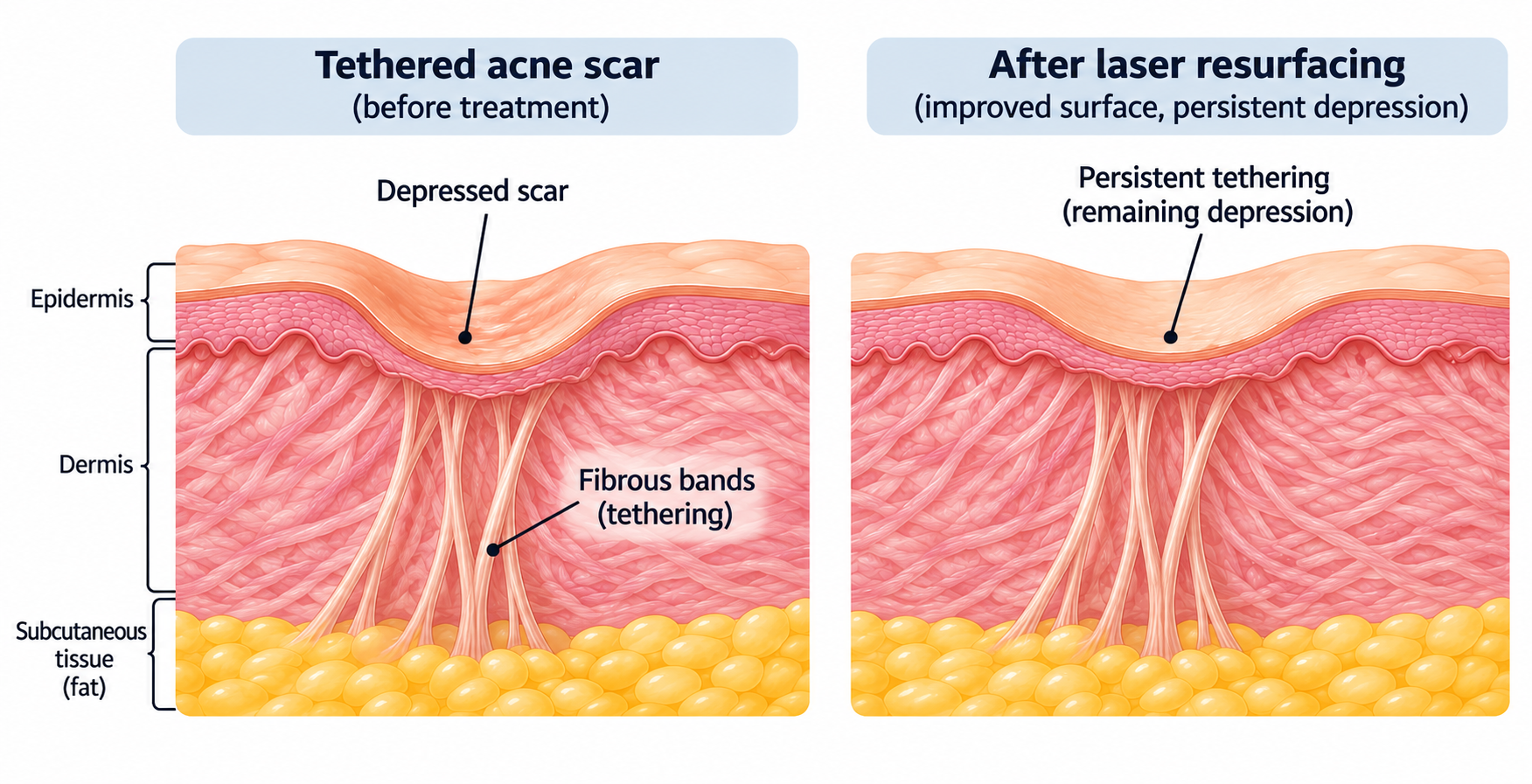
This happens because acne scars involve changes at different depths of the skin. Laser treatments encourage collagen remodelling and improve surface texture, but certain scars are held down by fibrous tissue that may not respond sufficiently to resurfacing alone.
For these scars, subcision may be considered to release the underlying attachments, while complementary treatments can address remaining textural irregularities. The appropriate approach depends on what is causing the scars to persist and how the skin has responded to previous treatment.
Fractional laser treatments create controlled microscopic injuries in the skin, stimulating repair and collagen production. Over time, this process can soften scar edges and improve uneven texture.
However, the response varies according to scar depth, shape and underlying tissue changes. A 2024 review of acne scar management emphasised that treatment selection should account for the structural differences between rolling, boxcar and ice-pick scars, as no single technique is equally effective for all three. [1]
Three factors are particularly relevant when scars remain visible after laser treatment.
During acne scar formation, collagen fibres can develop between the skin and deeper tissues. These attachments pull the surface downwards, producing depressed scars that remain noticeable even when the surrounding skin becomes smoother.
Laser energy can stimulate collagen remodelling, but persistent tethering may require a procedure that physically releases these attachments.
Shallow scars generally respond differently from deep, sharply defined depressions. Narrow ice-pick scars, for example, extend into deeper skin layers and may show limited improvement with conventional resurfacing.
A person with several scar types may therefore experience good improvement in some areas while others remain largely unchanged.
Collagen remodelling continues after laser treatment, and the full effect may take several months to develop. Treatment intensity also needs to account for skin phototype and the risk of post-inflammatory hyperpigmentation, which is particularly relevant in patients with darker skin tones.
These factors make it important to distinguish between incomplete healing and scars that genuinely require another treatment approach.
The appearance of a persistent scar can provide clues about its underlying structure. Atrophic acne scars are generally classified into three types.
| Scar type | Characteristic appearance | Treatment considerations |
| Rolling | Broad, shallow-looking depressions with sloping edges | Subcision may help when fibrous tethering is present |
| Boxcar | Round or oval depressions with defined borders | Resurfacing, focal techniques or selected surgical procedures |
| Ice-pick | Small, narrow openings extending deeply into the skin | TCA CROSS or selected surgical procedures |
Rolling scars are particularly relevant to subcision because their appearance is often influenced by fibrous bands beneath the skin.
A 2024 narrative review of atrophic acne scar treatments describes subcision as a technique for releasing these fibrotic strands, while procedures such as TCA CROSS and punch techniques are directed towards other scar characteristics. [2]
The distinction matters when deciding whether another laser session is likely to provide meaningful improvement. If a scar remains depressed because of tethering, additional resurfacing may have limited benefit until the underlying restriction is addressed.
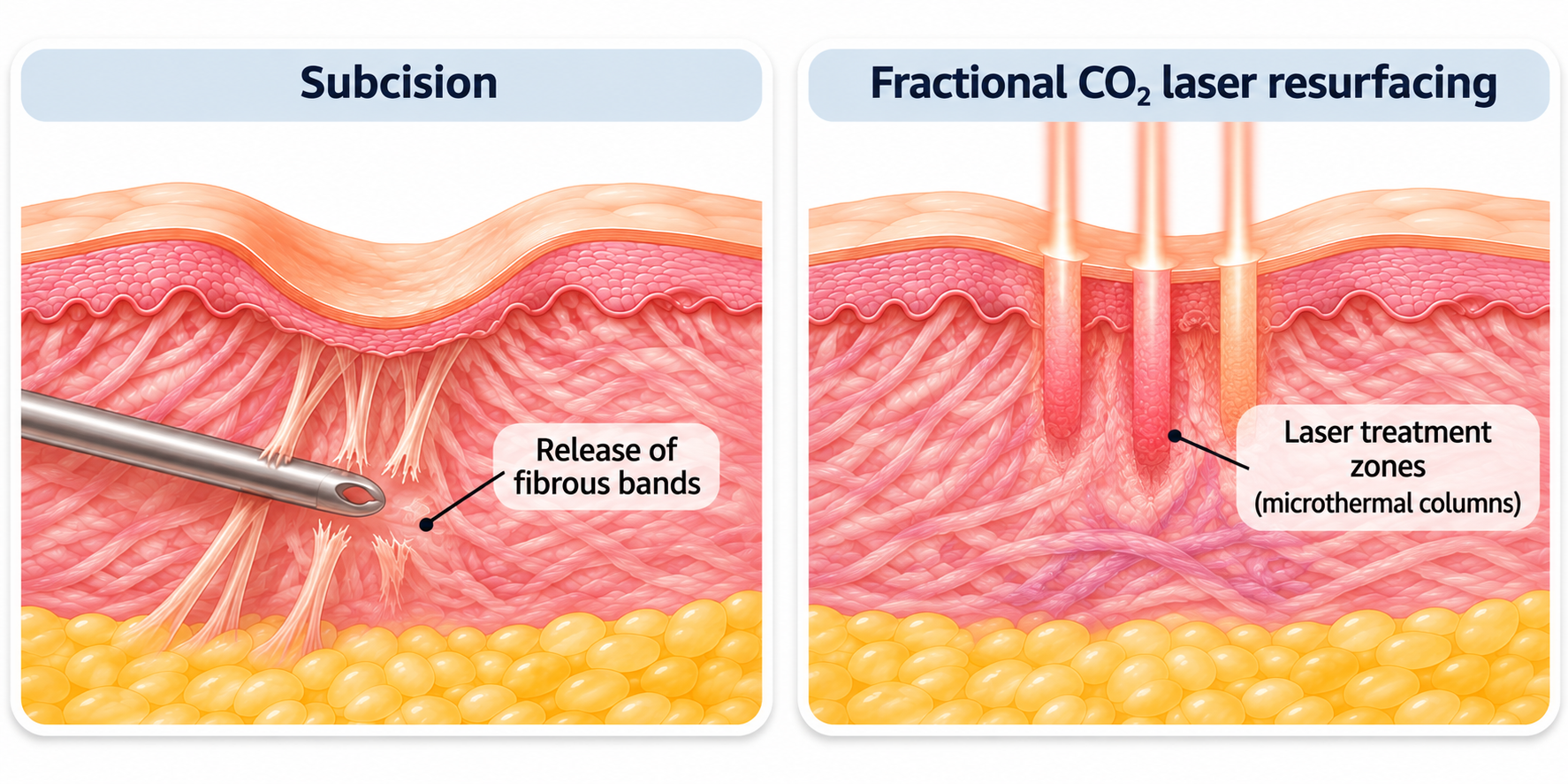
Subcision is a minimally invasive surgical technique used primarily for tethered atrophic acne scars. It works beneath the skin surface, targeting the fibrous attachments responsible for maintaining certain depressions.
After local anaesthesia, a doctor introduces a specialised needle or blunt-tipped cannula beneath the scar through a small entry point. The instrument is carefully manipulated to separate the fibrous bands from the surrounding tissue.
Once these attachments are released, the skin is less restricted and may rise closer to the level of the surrounding surface. The healing process can also encourage new connective tissue formation beneath the treated area.
Unlike laser resurfacing, which primarily stimulates tissue remodelling through controlled energy delivery, subcision mechanically releases the tissue responsible for tethering.
A comparative study published in the Journal of Cosmetic and Laser Therapy in 2026 examined 30 patients with atrophic facial acne scars. Participants received either fractional CO₂ laser treatment combined with subcision or fractional CO₂ laser alone.
The combination group demonstrated significantly greater improvement in acne scar grading scores (p = 0.007) and reported higher treatment satisfaction. [3]
These findings suggest that addressing fibrous attachments alongside resurfacing may improve outcomes for appropriately selected patients. However, the study involved a relatively small sample, and the results do not establish that every patient with residual scarring requires subcision.
Subcision is generally less suitable as a primary treatment for narrow ice-pick scars or scars without significant tethering.

Acne scars frequently involve more than one structural problem. A patient may have tethered rolling scars across the cheeks, sharply defined boxcar scars near the temples and smaller ice-pick scars in other areas.
In such cases, combining treatments allows different aspects of the scarring to be addressed.
The goal is not simply to perform more procedures. Each treatment should have a specific purpose based on the scars present.
Fractional CO₂ laser resurfacing can improve uneven texture and soften the edges of selected depressed scars by stimulating collagen remodelling.
When used alongside subcision, the two procedures address different features of scarring: subcision releases the underlying attachments, while laser treatment works on the remaining tissue irregularities.
A 2026 systematic review and network meta-analysis examined 56 randomised controlled trials involving 1,488 patients and 34 treatment interventions. Fractional CO₂ laser combined with subcision was among the highest-ranking approaches for improvement in Goodman–Baron acne scar scores and patient satisfaction. [4]
However, treatment rankings varied according to the outcome measured, and the authors highlighted the need for larger studies with standardised assessments and longer follow-up.
The timing of combination treatments depends on the condition of the skin, previous procedures and the expected recovery.
A 2024 split-face clinical trial involving 34 patients compared simultaneous and sequential fractional CO₂ laser and subcision treatments. Both approaches produced comparable improvements in atrophic acne scars.
The simultaneous approach was associated with greater swelling duration and higher pain during laser treatment, although overall downtime was shorter than with sequential treatment. [5]
This suggests that both treatment schedules may be viable, but neither is automatically preferable for every patient.
The doctor must consider healing time, treatment intensity and the potential for overlapping side effects before determining the sequence.
Subcision is most useful when fibrous tethering contributes to the depressed appearance of a scar. Other procedures may be considered when persistent scarring involves different tissue characteristics.
Radiofrequency (RF) microneedling delivers controlled thermal energy beneath the skin through fine needles. The resulting tissue response encourages collagen remodelling and may improve certain rolling and boxcar scars.
It may be considered when additional improvement in skin texture is needed, particularly where the treatment plan requires careful management of surface injury and pigmentation risk. RF microneedling can still cause swelling, pigmentation changes or other complications.
TCA CROSS involves applying concentrated trichloroacetic acid precisely within selected deep scars to stimulate localised tissue remodelling.
This technique is particularly relevant for ice-pick scars, which are often too narrow and deep to respond adequately to surface resurfacing. It may be included in a treatment plan when ice-pick scars coexist with rolling scars requiring subcision.
Some depressed scars may benefit from additional support beneath the skin after fibrous attachments have been released.
Hyaluronic acid fillers can provide volume in selected areas, although their effects are generally temporary. Fillers also carry risks, including nodules, infection and rare but serious vascular complications.
A randomised clinical study involving 40 patients compared subcision alone with subcision combined with either fractional CO₂ laser or cross-linked hyaluronic acid filler. The study investigated how adding a complementary treatment could influence outcomes in atrophic acne scars. [6]
The choice between these approaches depends on whether the remaining concern involves surface irregularity, volume loss or persistent structural depression.
The aim of treatment is to make acne scars less noticeable by improving their depth, contour and surrounding skin texture. Complete scar removal is rarely achievable, particularly when scars are deep or longstanding.
After subcision, some lifting may be apparent, but early swelling can temporarily exaggerate the improvement. A more reliable assessment is made once bruising and swelling have resolved and the skin has undergone further remodelling.
With laser or RF-based treatments, collagen changes generally develop gradually over the following months.
Several sessions may be needed, depending on the extent of scarring and the response to each procedure. Even after combination treatment, some depressions may remain visible.
A 2023 review of atrophic acne scar management found support for several procedural treatments but also highlighted differences in the quality of evidence across techniques. The authors noted the continuing need for better standardised treatment protocols. [7]
This reinforces the importance of setting realistic expectations and assessing improvement based on the individual scar pattern rather than assuming a particular procedure will produce a fixed percentage of correction.
Recovery varies depending on whether subcision is performed alone or combined with another procedure.
Following subcision, bruising, swelling and tenderness are common. These effects usually settle gradually, although bruising can remain visible for longer in some patients.
More significant complications can include haematoma, infection, pigmentation changes, persistent nodules or additional scarring.
Fractional CO₂ laser may involve several days of redness, swelling and superficial crusting. Recovery following RF microneedling or TCA CROSS depends on the treatment intensity and area involved.
When procedures are combined, the overall recovery may be more demanding. Patients should therefore discuss the anticipated downtime, aftercare requirements and potential complications before treatment.
Before recommending another procedure, the doctor should review the type of laser previously used, the number of sessions completed and the time elapsed since the last treatment.
The assessment should also consider whether the remaining scars are tethered, whether active acne is present and whether the skin has developed pigmentation changes or other complications.
For some patients, allowing more time for collagen remodelling may be appropriate. Others may benefit from a different technique once the skin has recovered.
Persistent acne scars after laser treatment do not necessarily require more aggressive resurfacing. The next step depends on whether the remaining depressions are caused by fibrous tethering, deeper tissue loss or surface irregularities.
At Apax Medical in Singapore, Dr Moses Ng provides acne scar assessments and treatments including subcision, fractional laser resurfacing, RF microneedling and TCA CROSS.
A consultation can help determine whether further laser treatment, subcision or a combination approach is suitable for the scars that remain.
Some scars may become depressed again if fibrous attachments reform or the initial release is incomplete. The extent of improvement depends on scar characteristics, technique and individual healing.
Local anaesthesia is typically used to reduce discomfort during treatment. Patients may experience pressure or pulling sensations, followed by tenderness and bruising during recovery.
Subcision may be suitable for patients with darker skin phototypes, but pigmentation risk, healing characteristics and any accompanying resurfacing procedures require careful assessment.
Some scars improve after one session, while more extensive or deeply tethered scarring may require additional treatment. The number of sessions cannot be determined reliably without examining the scars.


Dr. Moses Ng is a distinguished professional in the field of aesthetic medicine, renowned for his expertise in advanced cosmetic procedures. With over 15 years of experience, extensive training and a keen eye for detail, Dr. Ng specializes in a wide range of treatments, including injectables, laser therapies, and acne scar management.
Dr. Moses Ng’s commitment to excellence and patient-centric approach have earned him a reputation as a trusted clinician in aesthetic medicine. His continuous pursuit of the latest advancements in the field ensures that his patients receive the highest standard of care and the most effective treatments available.


